
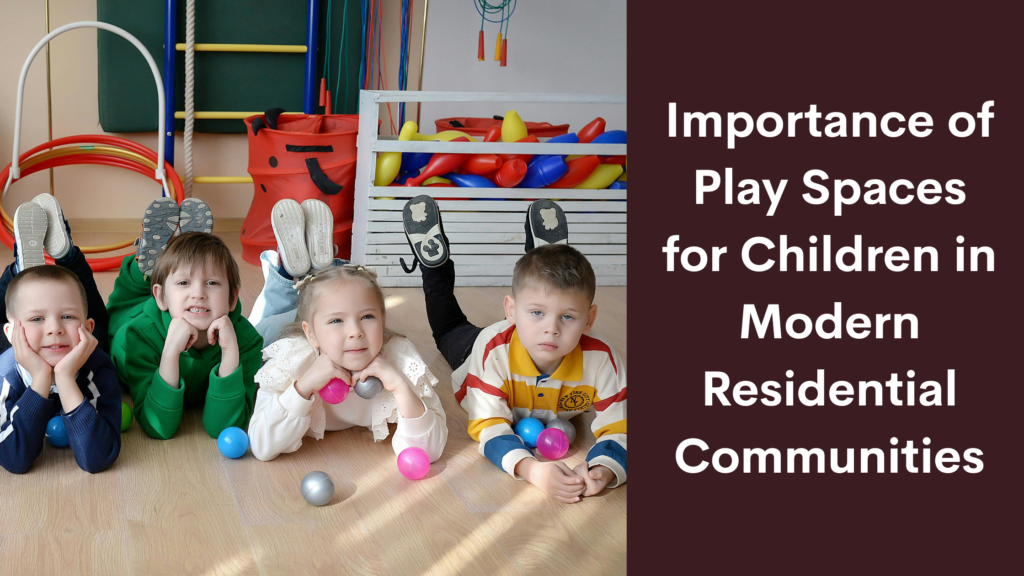
The first time your child laughs — really laughs — it isn’t usually at a toy or a screen. It’s when they’re tumbling on grass, splashing in a puddle, or chasing a friend across an open lawn. That sound, that pure, breathless joy, is something every parent instinctively wants to protect and nurture. Yet in the rush of choosing a new home, many of us focus on square footage, marble countertops, and parking spots. We forget to ask the question that matters most:
Where will my child play?
This isn’t a small question. The quality of outdoor and communal play spaces in a residential community has a direct, measurable impact on a child’s physical health, emotional intelligence, and social development. For new parents standing at the threshold of one of life’s biggest decisions, understanding this can change everything about where you choose to live — and how your child grows up.
The Science of Play: Why It’s Not Optional
Decades of research in child development confirm what grandmothers always knew: children who play freely, regularly, and in safe outdoor environments develop stronger bodies, sharper minds, and richer emotional lives. The American Academy of Pediatrics has categorically identified unstructured play as essential to healthy brain development. It builds executive function — that precious ability to plan, focus, and self-regulate — more effectively than any structured curriculum can in the early years.
When a toddler negotiates the rules of a made-up game with a neighbour’s child, they are learning conflict resolution. When a seven-year-old climbs a structure just a little higher than yesterday, they are building physical courage and calculating risk. When a group of kids invents a world on a patch of grass with sticks and imagination, they are developing the very creativity that will define their future careers.
None of this happens on a sofa. It happens in the spaces between buildings — in the parks, courts, gardens, and open lawns that a residential community either provides or doesn’t.
What a Thoughtfully Designed Residential Community Looks Like
Not all housing communities are created equal — especially when it comes to children. There is a profound difference between an apartment complex that has a sad, underused swing set in the corner and a purposefully designed residential community that places children’s wellbeing at the centre of its vision.
Forward-thinking developers understand that families don’t just buy homes; they invest in a way of life. Livhola represents the kind of residential community philosophy that new parents should look for — one that treats communal spaces, greenery, and family-friendly environments not as afterthoughts but as essential pillars of the living experience. When you’re evaluating residential options, look for communities that integrate play into their very DNA.
So what should you actually look for? Here are the non-negotiables:
Age-segregated play zones: A toddler has entirely different needs from a ten-year-old. Well-designed communities create distinct zones — soft-surface sensory areas for the very young, adventure play structures for older children, and open multipurpose courts for teenagers.
Visibility and safety: Parents need to be able to see their children from common seating areas. Well-lit, open spaces with natural surveillance aren’t just a convenience — they are a safety imperative.
Green cover and natural elements: Sand pits, water features, mud kitchens, and trees to climb have been shown to produce more developmental benefits than conventional plastic playground equipment. Nature-based play is increasingly a marker of premium, family-conscious communities.
Proximity to home: The play area must be close enough that a child can walk there independently as they grow older. This independence — knowing that the park is just downstairs — is foundational to a child’s growing confidence and sense of freedom.
The Invisible Cost of Neglected Play Spaces
Here is the uncomfortable truth that many real estate brochures won’t tell you: a beautifully photographed play area and a well-maintained one are two very different things.
Play spaces that look stunning on launch day can deteriorate quickly without proper upkeep. Cracked surfaces, rusted equipment, and unhygienic sandpits aren’t just eyesores — they’re genuine hazards. Fungal growth in damp corners, allergen build-up in soft play areas, and grime on frequently touched surfaces pose real health risks to young children whose immune systems are still developing.
This is where the operational backbone of a residential community becomes just as important as its design. Parents often underestimate how much the day-to-day cleanliness and maintenance of shared spaces impacts their family’s quality of life — until their child picks up a recurring infection, or they notice the community pool has been closed for the third time this year.
Choosing a community that partners with professional facility and cleaning services is not a luxury; it’s a baseline requirement for family living. Services like Lura specialise in the kind of thorough, scheduled cleaning that keeps communal areas — from playground equipment and pool decks to lift lobbies and common corridors — genuinely safe and hygienic for children. When a residential management team takes cleaning seriously, it signals something broader: that they respect the families who live there.
Community Is the Other Word for Childhood
There is something else that play spaces do that we rarely talk about directly — they build community. Not just for children, but for parents too.
When your daughter makes a friend at the community playground, you exchange numbers with that child’s mother. When your son has a fall, a neighbour you’ve never spoken to runs over to help. When kids from different apartments form a cricket team on the community lawn, their parents gradually become something that modern urban life rarely produces: actual neighbours.
This social fabric — invisible, informal, irreplaceable — is one of the most powerful things a well-designed residential community can offer a growing family. Research on childhood wellbeing consistently shows that children who grow up in socially connected neighbourhoods exhibit lower rates of anxiety, greater resilience, and stronger academic outcomes. The play space is where this connection begins.
For new parents, this is worth pausing on. You are not just choosing a home. You are choosing the first community your child will belong to. You are choosing their first friends, their first sense of neighbourhood, their first experiences of navigating the world beyond your front door. That decision deserves more weight than the kitchen layout.
Making the Right Choice: A Checklist for New Parents
When visiting or researching potential new homes, run through these questions with the same rigour you’d apply to EMIs and floor plans:
- Is there a dedicated children’s play area, and is it proportionate to the number of families in the community?
- Are the play surfaces and equipment age-appropriate and well-maintained?
- Is the play area visible from sitting areas where parents can supervise comfortably?
- Does the community have green open spaces — not just manicured gardens, but spaces where children can run freely?
- How does the facility management handle cleanliness and maintenance of communal areas?
- Are there rules about maintenance frequency, and are they actually followed?
- Are there family-friendly community activities, events, or spaces that encourage neighbours to connect?
- Is there a teen or pre-teen zone, or will your child outgrow the community’s recreational offerings by age 10?
Don’t be shy about asking the developer or management team these questions directly. Their answers — and their willingness to answer — will tell you a great deal about the values that shape their community.
The Biggest Investment Isn’t the One You Think
You will spend your child’s entire childhood wishing you could give them more: more time, more experiences, more of the world. The beautiful secret of a great residential community is that it does some of that giving for you — quietly, daily, in the years when it matters most.
A safe swing set on a clean, green lawn may seem like a minor amenity. But to the child who comes home flushed and happy every evening, and to the parent watching from the bench above — it is the whole world.
Choose the community that understands this. Choose the home that treats your child’s play as seriously as your mortgage. And know that the quality of the spaces between buildings will shape your child’s life in ways that no interior designer ever could.

Amruta Nadar is the Co-founder and Marketing Head at ChildFuturePlan.com. She has over 10 years of experience in Digital Marketing and has helped over hundreds of clients to succeed in the business. With ChildFuturePlan, she focuses on helping parents plan their child’s education, financial security, and future milestones through practical insights and simplified financial concepts. When she is not at her desk, you will see her gardening, cooking, walking, or just meditating!
- Amruta Nadar
- Amruta Nadar
- Amruta Nadar